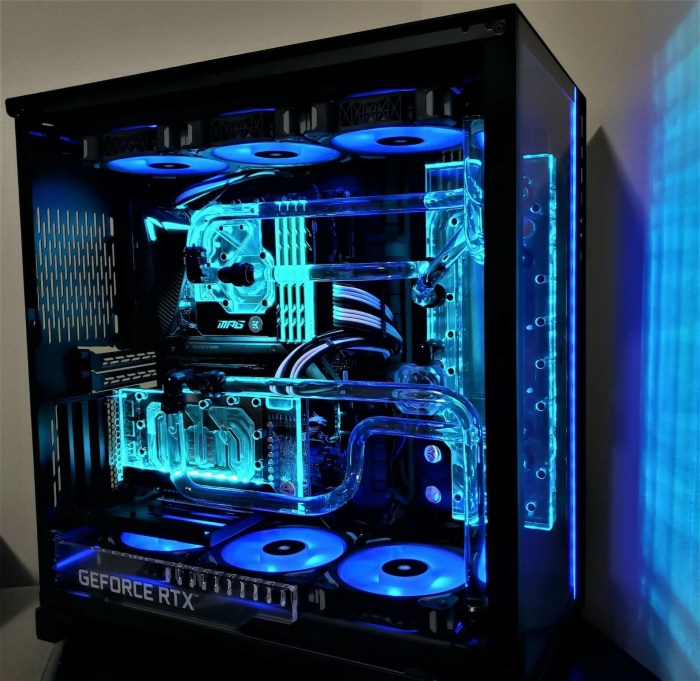
Ever dreamt of crafting the ultimate gaming rig? Forget pre-built PCs; dive into the exciting world of custom-built gaming machines! This isn’t just about assembling parts; it’s about meticulously selecting components to create a powerhouse perfectly tailored to your gaming needs and budget. From choosing the right CPU and GPU to mastering cable management, we’ll guide you through every step, transforming you from a gaming enthusiast into a PC-building pro.
We’ll explore the current market trends, analyze the best components for different budgets, and walk you through the entire building process. Learn to troubleshoot common problems, optimize your system for peak performance, and even delve into the fascinating world of online game development (though we’ll leave the actual coding to the experts!). Prepare for a deep dive into the thrilling realm of personalized gaming power.
Market Overview: Gaming PC Custom Builds
The market for custom-built gaming PCs is experiencing robust growth, fueled by the increasing demand for high-performance systems capable of handling the latest AAA titles and demanding applications. This surge isn’t simply a fleeting trend; it reflects a fundamental shift in how gamers approach their hardware, prioritizing personalized performance and aesthetics over pre-built options.This burgeoning market is driven by a diverse demographic, but several key groups stand out.
Enthusiast gamers, seeking the ultimate in performance and customization, form a significant segment. Professional streamers and esports athletes also represent a substantial portion, requiring top-tier hardware for optimal gameplay and broadcast quality. Finally, a growing number of creative professionals, such as video editors and 3D modelers, are turning to custom-built PCs for their power and flexibility.
Pricing Strategies of Custom PC Builders
Custom PC builders employ various pricing strategies to attract different customer segments. Some focus on offering high-end components at premium prices, targeting users who prioritize top-of-the-line performance. Others concentrate on providing budget-friendly builds, utilizing cost-effective components while still delivering satisfactory gaming experiences. A third approach involves offering a tiered system, with various build options at different price points to cater to a wider range of budgets and needs.
For example, a builder might offer a “budget gamer” build starting around $800, a “mid-range enthusiast” build around $1500, and a “high-end pro” build exceeding $3000, each using progressively more powerful components. Competition among builders often leads to dynamic pricing, with occasional sales and promotions influencing the overall market cost.
Popular Components in Custom Gaming PCs
The following table highlights the most frequently chosen components in custom gaming PC builds, reflecting current market trends and user preferences. Component selection is heavily influenced by the desired performance level and budget.
| Component | Popular Brands | Typical Specifications | Price Range (USD) |
|---|---|---|---|
| CPU (Processor) | Intel (Core i5, i7, i9), AMD (Ryzen 5, 7, 9) | 6-16 cores, high clock speeds | $150 – $800+ |
| GPU (Graphics Card) | Nvidia (GeForce RTX 30/40 series), AMD (Radeon RX 6000/7000 series) | 8GB-24GB VRAM, high clock speeds, Ray Tracing capabilities | $300 – $2000+ |
| RAM (Memory) | Corsair, G.Skill, Crucial | 16GB-32GB DDR4/DDR5, high speed (3200MHz-6000MHz+) | $50 – $200+ |
| Storage (SSD/HDD) | Samsung, Western Digital, Crucial | 1TB-4TB NVMe SSD (primary), optional HDD for mass storage | $50 – $300+ |
Component Selection
Building a high-performance gaming PC requires careful consideration of each component. The right combination will deliver a smooth, immersive gaming experience, while the wrong choices can lead to frustrating bottlenecks and subpar performance. Let’s delve into the key factors influencing component selection.
CPU Selection for Gaming PCs
Choosing the right CPU (Central Processing Unit) is crucial for overall system responsiveness and gaming performance. Factors to consider include core count and clock speed, cache size, and the CPU’s TDP (Thermal Design Power). Higher core counts generally translate to better performance in multi-threaded applications, while a higher clock speed improves single-threaded performance, which is often more critical in gaming.
A larger cache improves data access speeds, leading to faster processing. TDP determines the amount of heat generated, impacting cooling requirements. For example, a high-end gaming CPU like the AMD Ryzen 9 7950X3D offers a significant advantage in gaming due to its high core count and large 3D V-Cache, whereas a more budget-friendly option like the Intel Core i5-13600K might be sufficient for 1080p gaming.
GPU Architectures and Their Impact on Gaming Performance
Graphics Processing Units (GPUs) are the heart of a gaming PC, responsible for rendering the visuals. Different architectures from NVIDIA (e.g., Ampere, Ada Lovelace) and AMD (e.g., RDNA 2, RDNA 3) offer varying levels of performance and features. Key differences lie in the number of CUDA cores (NVIDIA) or Stream Processors (AMD), memory bandwidth, and the implementation of ray tracing and DLSS/FSR technologies.
For instance, NVIDIA’s Ada Lovelace architecture boasts significant improvements in ray tracing performance compared to its Ampere predecessor, while AMD’s RDNA 3 offers competitive performance at potentially lower price points. The choice depends on budget and desired features; a high-end card like the NVIDIA GeForce RTX 4090 delivers unparalleled performance, while a mid-range card like the AMD Radeon RX 7800 XT provides excellent value.
RAM Types and Suitability for Gaming
Random Access Memory (RAM) is essential for storing data that the CPU needs to access quickly. The primary factors to consider are speed (measured in MHz), capacity (measured in GB), and type (DDR4, DDR5). Faster RAM generally leads to smoother gameplay and reduced loading times, especially in high-resolution gaming. Higher capacities are beneficial for multitasking and running memory-intensive games.
DDR5 RAM offers higher speeds and bandwidth compared to DDR4, but it’s also more expensive. For gaming, 16GB of DDR5 RAM is generally sufficient for most current titles, although 32GB provides future-proofing for more demanding games and applications.
Sample High-End Gaming PC Build
This build prioritizes high-end performance and future-proofing:
| Component | Specific Model | Justification |
|---|---|---|
| CPU | AMD Ryzen 9 7950X3D | Exceptional gaming performance due to high core count and 3D V-Cache. |
| CPU Cooler | Noctua NH-D15 | High-performance air cooler to handle the Ryzen 9’s TDP effectively and quietly. |
| Motherboard | ASUS ROG Crosshair X670E Hero | High-end motherboard with robust features and excellent compatibility. |
| GPU | NVIDIA GeForce RTX 4080 | High-end graphics card for exceptional visual fidelity and frame rates at high resolutions. |
| RAM | 32GB (2x16GB) DDR5-6000 CL30 | High-speed RAM for smooth gameplay and future-proofing. |
| Storage | 2TB NVMe PCIe 4.0 SSD | Fast storage for quick game loading times. |
| Power Supply | 1000W 80+ Gold Certified PSU | Sufficient power for the high-end components and future upgrades. |
| Case | Corsair 5000D Airflow | Excellent airflow for effective cooling. |
Building Process

So, you’ve meticulously chosen your components – congratulations! Now comes the fun part: assembling your dream gaming rig. This process might seem daunting at first, but with a methodical approach and a little patience, you’ll be gaming in no time. Remember, taking your time and double-checking each step is crucial to avoid costly mistakes.
Building a PC is a rewarding experience that allows you to understand your machine’s inner workings. This step-by-step guide will walk you through the process, offering tips and tricks along the way. Remember to consult your component manuals for specific instructions, as they may vary slightly depending on the manufacturer.
Preparing the Workspace and Gathering Tools
Before you even touch a component, prepare a clean, well-lit workspace. Static electricity can damage sensitive components, so consider using an anti-static wrist strap connected to a grounded surface. Having all your tools readily available will streamline the process.
A well-organized workspace significantly reduces the risk of accidental damage and simplifies the assembly process. This preparation minimizes the chances of errors and ensures a smoother build.
- Anti-static wrist strap
- Phillips head screwdriver (magnetic tip is highly recommended)
- Zip ties or Velcro straps for cable management
- Small parts tray to keep screws organized
- Optional: thermal paste applicator
Installing the CPU and Cooler
Carefully remove the CPU’s protective cover and align it with the socket on the motherboard. Gently lower the CPU into the socket, ensuring it clicks into place. Then, apply thermal paste (a small pea-sized amount is usually sufficient) to the CPU’s heat spreader before installing the CPU cooler. Ensure the cooler is properly secured to the motherboard.
Improper installation can lead to overheating and system instability.
Applying the correct amount of thermal paste is crucial for optimal heat transfer. Too much or too little can negatively impact CPU performance and longevity.
Installing RAM
Locate the RAM slots on the motherboard (usually colored or clearly marked). Gently push the RAM sticks into the slots until they click into place. Ensure they are firmly seated. Modern RAM modules usually have a notch to prevent incorrect installation.
Ensure the RAM is correctly seated in the slots, and that the clips on the sides of the RAM slots firmly hold the RAM in place.
Mounting the Motherboard in the Case
Carefully place standoffs in the case (these are small screws that elevate the motherboard to prevent short circuits). Then, align the motherboard with the standoffs and gently lower it into place. Secure it with the provided screws.
Using standoffs is crucial to prevent short circuits that could damage your components. Make sure all standoffs are properly placed before installing the motherboard.
Installing the GPU and Storage Devices
Insert the graphics card into the appropriate PCIe slot on the motherboard, ensuring it’s firmly seated. Connect your storage devices (SSD/HDD) to the motherboard using SATA cables and power cables from the PSU.
Properly securing the GPU and storage devices prevents connection issues and potential damage during operation. Ensure that all cables are securely connected.
Connecting the Power Supply Unit (PSU)
Connect the PSU to the motherboard, GPU, and storage devices using the appropriate cables. Refer to your PSU and motherboard manuals for the correct cable connections.
Connecting the PSU correctly is crucial for the system’s functionality. Incorrect connections can lead to system failure or damage to components.
Cable Management
Neatly route and secure all cables using zip ties or Velcro straps. Good cable management improves airflow, reducing temperatures and improving system stability, and enhances the overall aesthetics of your build.
Effective cable management enhances airflow, which directly impacts cooling efficiency and system stability. A clean build also looks much more professional.
Initial Boot and Troubleshooting
Once everything is connected, connect your monitor, keyboard, and mouse. Power on your PC. If you encounter problems, check the following:
- Ensure all components are properly connected.
- Verify the RAM is correctly installed.
- Check the power supply connections.
- Check the monitor and keyboard connections.
Troubleshooting is a critical step in the building process. Identifying and resolving issues early prevents major headaches later.
Software and Optimization
You’ve built your dream gaming PC, but the hardware is only half the battle. The right software and careful optimization are crucial for unlocking its full potential and ensuring a smooth, lag-free gaming experience. This section will guide you through selecting the best operating system, installing essential drivers and software, and fine-tuning Windows settings for peak performance.
Operating System Selection for Gaming PCs
Choosing the right operating system is the foundation of a great gaming experience. While several options exist, Windows remains the dominant player in the PC gaming world due to its vast game compatibility and robust driver support. Specifically, Windows 10 and Windows 11 offer the best balance of features, performance, and game compatibility. Windows 11 boasts some performance improvements over Windows 10, particularly with DirectX 12 Ultimate, but the difference is often marginal unless you’re using cutting-edge hardware.
Ultimately, the choice often comes down to personal preference and hardware compatibility. Consider checking the minimum system requirements of your favorite games to ensure compatibility.
Driver Installation and Software Configuration
Once your operating system is installed, installing the correct drivers is paramount. This involves downloading and installing the latest drivers for your graphics card (GPU), motherboard, sound card, and other peripherals directly from the manufacturer’s website. Using outdated or incorrect drivers can lead to performance issues, crashes, and incompatibility with certain games. After installing drivers, consider installing other essential software like your preferred antivirus program (ensure it doesn’t aggressively impact gaming performance), gaming launchers like Steam or Epic Games Store, and any required software for peripherals such as controllers or headsets.
Always ensure your software is up-to-date to benefit from performance enhancements and bug fixes.
Optimizing Windows Settings for Gaming Performance
Windows offers several settings that can significantly impact gaming performance. Optimizing these settings can result in noticeable improvements in frame rates and overall responsiveness. For example, disabling unnecessary startup programs reduces system load, freeing up resources for games. Adjusting the power plan to “High Performance” ensures your CPU and GPU are running at their maximum potential. Furthermore, tweaking in-game graphics settings, such as reducing shadow quality or turning off anti-aliasing, can significantly boost frame rates, especially on less powerful systems.
Turning off background applications and processes that aren’t necessary while gaming can also improve performance.
Software Optimization Checklist
Before diving into your gaming session, running through this checklist will ensure your system is primed for optimal performance:
- Update all drivers: Ensure all drivers are up-to-date from the manufacturer’s website.
- Close unnecessary background applications: Minimize the number of programs running in the background to free up system resources.
- Adjust Windows power plan to “High Performance”: This ensures maximum CPU and GPU utilization.
- Disable Windows Game Mode (Optional): While intended to improve gaming performance, Game Mode sometimes has the opposite effect. Experiment to see if disabling it provides better results.
- Optimize in-game graphics settings: Find a balance between visual fidelity and performance. Reduce settings that have minimal visual impact but significantly affect performance, such as shadows or anti-aliasing.
- Run a disk cleanup: Regularly remove temporary files and unnecessary data to free up hard drive space and improve loading times.
- Defragment your hard drive (if applicable): If using a traditional HDD, defragmentation can improve loading times.
- Update Windows: Install the latest Windows updates for potential performance enhancements and bug fixes.
Online Game Development and Related Topics
Creating a successful multiplayer online game is a complex undertaking, requiring a blend of technical expertise, artistic vision, and a deep understanding of player psychology. The process involves numerous stages, from initial concept design to ongoing maintenance and updates, demanding a dedicated and skilled team. This section delves into the intricacies of online game development, highlighting key challenges, engine comparisons, and monetization strategies.
Multiplayer Online Game Development Process
The development of a multiplayer online game typically follows a phased approach. It begins with conceptualization, defining the game’s core mechanics, setting, and target audience. This phase is followed by pre-production, encompassing detailed design documents, prototyping, and technology selection. Production involves the actual development, encompassing programming, art creation, sound design, and testing. Finally, post-production includes launch, ongoing maintenance, and content updates to retain player engagement.
Each phase requires meticulous planning and coordination across various teams, ensuring a seamless and engaging final product. For example, a game like Fortnite went through years of development, including multiple iterations of gameplay and engine changes, before its final release.
Key Challenges in Online Game Development
Online game development presents unique challenges not found in single-player titles. Network latency and stability are critical concerns, directly impacting gameplay experience. Scalability, the ability to handle a growing player base, is equally vital. Balancing gameplay, ensuring fairness and preventing exploits, requires ongoing monitoring and adjustments. Security, protecting the game against hacking and cheating, is paramount.
Finally, maintaining player engagement over time demands consistent content updates and community management. Consider the issues faced by massively multiplayer online role-playing games (MMORPGs) like World of Warcraft, which must continuously update content to keep millions of players engaged.
Comparison of Game Engines Used in Online Game Development
Several game engines are popular choices for online game development, each with its strengths and weaknesses. Unity, known for its ease of use and cross-platform compatibility, is a popular choice for indie developers and smaller studios. Unreal Engine, favored for its high-fidelity graphics and robust tools, is often selected for AAA titles. Other engines, such as Amazon Lumberyard and CryEngine, offer specific features and functionalities catering to different needs.
The choice of engine depends on factors such as budget, team expertise, and target platform. For example, many mobile games utilize Unity due to its ease of mobile deployment, while large-scale PC games might leverage Unreal Engine for its advanced rendering capabilities.
Monetization Strategies in Online Games
Online games employ various monetization strategies, often in combination. The freemium model, offering a base game for free with optional in-app purchases, is widely used. Subscription models provide ongoing access to content for a recurring fee. Direct sales involve a one-time purchase for the full game. Microtransactions, offering virtual items or enhancements for purchase, are a common revenue stream.
Finally, advertising can be integrated, though it often requires careful balancing to avoid disrupting gameplay. Games like League of Legends utilize a freemium model with cosmetic purchases, while others, like World of Warcraft, rely on a subscription-based model. The most successful monetization strategies are those that feel fair and rewarding to players, encouraging spending without feeling exploitative.
Online Games and Driving/Racing Simulations
The popularity of online driving and racing games has exploded in recent years, fueled by advancements in technology, improved internet infrastructure, and the inherent thrill of virtual competition. These games offer a diverse range of experiences, from arcade-style racers to hyper-realistic simulations, catering to a broad spectrum of players, from casual gamers to dedicated esports athletes. The immersive nature of these games, coupled with the social aspect of online multiplayer, has cemented their place as a major force in the gaming industry.The appeal of online racing games stems from their ability to replicate the excitement of real-world motorsport in a readily accessible and customizable environment.
Players can compete against others worldwide, fine-tune their virtual vehicles, and progress through challenging career modes, all within the comfort of their own homes. This accessibility, combined with the competitive element, creates a compelling and engaging gaming experience.
Popular Online Racing Games: A Comparison
Several online racing games dominate the market, each boasting unique features and gameplay styles. Comparing these games reveals the diverse approaches developers take to create compelling racing experiences.
- Forza Horizon 5: This open-world racer emphasizes exploration and a vibrant, ever-changing environment. Its accessible gameplay and extensive car roster make it a popular choice for casual and hardcore players alike. The game’s focus is less on strict simulation and more on fun and freedom.
- Gran Turismo 7: Known for its commitment to realism, Gran Turismo 7 features highly detailed car models and meticulously recreated tracks. Its physics engine is renowned for its accuracy, making it a favorite among simulation enthusiasts. The game’s emphasis is on realistic handling and precise driving.
- iRacing: This subscription-based service offers a highly realistic and competitive racing experience. Its focus on accurate physics and competitive racing makes it popular among sim racers and esports professionals. The emphasis is on skill and precision, demanding a higher level of commitment from players.
- Assetto Corsa Competizione: This game specializes in GT3 racing, providing a highly realistic simulation of these prestigious events. It is known for its challenging handling and accurate depiction of racing dynamics. The focus is on realistic racing experiences, demanding technical driving skills.
Physics Engines in Realistic Driving Simulations
Realistic driving simulations rely heavily on sophisticated physics engines to accurately model the behavior of vehicles. These engines take into account numerous factors, including tire grip, aerodynamics, suspension, and engine power, to create a realistic driving experience. The complexity of these engines varies greatly depending on the game, with some focusing on simplified models for broader accessibility and others striving for extreme accuracy.
The most advanced physics engines utilize complex mathematical models and algorithms to simulate the intricate interactions between the vehicle and the environment. These models can incorporate factors such as tire deformation, suspension geometry, and aerodynamic downforce, resulting in highly realistic vehicle behavior.
Virtual Reality in Online Driving Games
The integration of virtual reality (VR) technology has significantly enhanced the immersion and realism of online driving games. VR headsets provide a first-person perspective that immerses players in the virtual world, making them feel like they are actually behind the wheel. This heightened sense of presence can significantly improve the gaming experience, making races feel more intense and engaging.
While VR adoption in racing games is still growing, its potential to revolutionize the genre is undeniable. Games like Assetto Corsa Competizione and iRacing offer strong VR support, further enhancing their already impressive realism. The tactile feedback provided by some VR controllers adds another layer of immersion, enhancing the sense of control and connection to the virtual vehicle.
Ending Remarks
Building your own gaming PC is more than just assembling parts; it’s a journey of customization and optimization. From understanding the intricacies of component selection to mastering the art of cable management, this guide has equipped you with the knowledge to build a gaming rig that truly reflects your unique style and performance demands. So, grab your tools, choose your components, and get ready to experience the unparalleled satisfaction of owning a custom-built gaming PC that’s truly your own.
The power is in your hands!
Questions and Answers
What’s the difference between an Intel and AMD CPU?
Intel and AMD CPUs both offer excellent gaming performance. Intel often boasts slightly higher single-core clock speeds, beneficial for some games, while AMD typically provides more cores at a similar price point, advantageous for multitasking and future-proofing.
How often should I upgrade my gaming PC?
Upgrade frequency depends on your budget and gaming demands. High-end components can last 3-5 years before significant performance drops, while budget components may need replacing sooner. Consider upgrading individual components (like the GPU) rather than a full rebuild.
What is liquid cooling, and do I need it?
Liquid cooling uses a liquid coolant to dissipate heat from the CPU and GPU, offering better cooling performance than air cooling, especially for high-end components. It’s not essential for all builds but highly recommended for overclocking or high-performance systems.
Can I reuse components from my old PC?
Potentially! Assess the age and condition of your existing components. A newer GPU or CPU might be bottlenecked by older RAM or a power supply that can’t handle the increased power draw. Check compatibility before reuse.