Ever wondered what’s behind the booming world of console subscription services? It’s a landscape filled with fierce competition, innovative online games, and a constantly evolving business model. From the giants like PlayStation Plus and Xbox Game Pass to the rising contenders, these services are reshaping how we experience video games. This exploration delves into the market dynamics, the impact of online gaming development, genre analysis, the intriguing role of gambling content (or lack thereof!), the economic aspects, and the exciting future of this rapidly expanding industry.
Get ready for a rollercoaster ride through the world of pixels, subscriptions, and potential profits!
We’ll examine the pricing strategies employed by various services, comparing their game libraries, online features, and exclusive content. We’ll also explore how the rise of online multiplayer games and advancements in online game development are fueling this subscription boom. Prepare to uncover the secrets behind successful game genres within these services, and we’ll even speculate on the potential (and ethical considerations) of integrating gambling features into the mix.
Finally, we’ll look towards the future, considering the impact of emerging technologies like cloud gaming and predicting the next big developments in this ever-evolving market.
Market Overview of Console Subscription Services
The console gaming market has seen a significant shift towards subscription services, offering gamers a compelling alternative to purchasing individual games at full price. This evolving landscape presents a complex interplay of pricing strategies, game libraries, and added features, creating a diverse range of options for consumers. Understanding this market is crucial for both gamers seeking the best value and industry analysts tracking the growth of this lucrative sector.
Key Players and Market Share
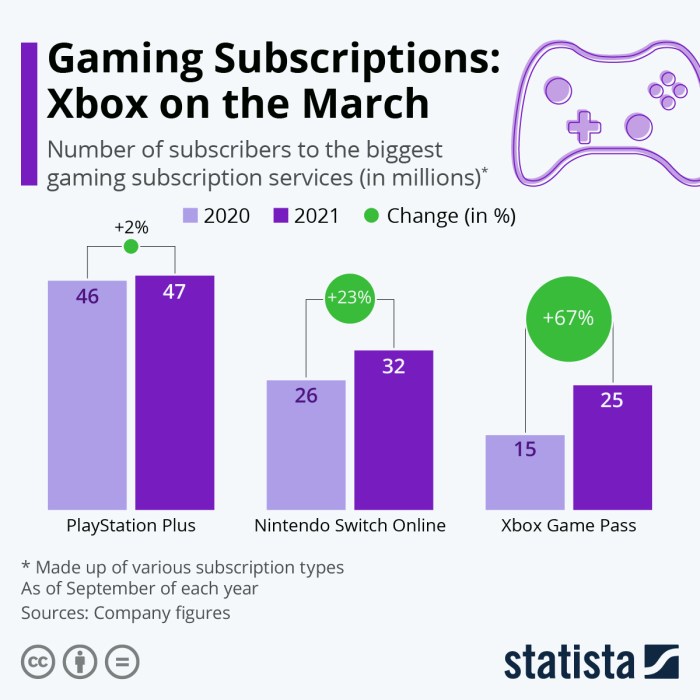
The console subscription service market is dominated by a few major players, each with its own unique approach and target audience. While precise market share figures fluctuate and are often proprietary information, we can identify the key contenders. Sony’s PlayStation Plus is a significant player, benefiting from the large PlayStation user base. Microsoft’s Xbox Game Pass, with its expansive library and PC integration, holds a strong position.
Nintendo’s Nintendo Switch Online, while offering a more limited scope, caters to its dedicated fanbase. Other smaller players exist, often focusing on niche genres or specific regions. The competitive landscape is dynamic, with ongoing adjustments to pricing and features reflecting the evolving consumer preferences and technological advancements.
Pricing Models and Features
Subscription services employ diverse pricing models to attract various consumer segments. Many offer tiered subscription levels, providing a range of features at different price points. For example, a basic tier might offer only online multiplayer access, while higher tiers unlock access to extensive game libraries, exclusive content, and additional perks like cloud saves or early access to new titles.
This tiered approach allows companies to capture a wider customer base, catering to both budget-conscious gamers and those seeking premium experiences. Features often include online multiplayer functionality, access to a catalog of games (varying in size and quality across services), and sometimes cloud gaming capabilities.
Value Proposition Comparison
The value proposition of each service hinges on its specific offerings and target audience. PlayStation Plus emphasizes online multiplayer and a curated selection of PlayStation games, appealing to players invested in the PlayStation ecosystem. Xbox Game Pass boasts a significantly larger library, including day-one releases from Xbox Game Studios, making it attractive to gamers seeking a diverse range of titles.
Nintendo Switch Online focuses on online multiplayer for classic and modern Nintendo Switch titles, appealing to fans of Nintendo’s franchises. The value ultimately depends on individual gaming preferences and the importance placed on specific features like game library size, online functionality, or exclusive content.
Comparison Table of Console Subscription Services
| Service | Price (Approximate Monthly) | Game Library Size (Approximate) | Online Features | Exclusive Content |
|---|---|---|---|---|
| PlayStation Plus (Premium Tier) | $17 | Hundreds | Online Multiplayer, Cloud Streaming | Classic PlayStation games, early access to trials |
| Xbox Game Pass Ultimate | $17 | Hundreds | Online Multiplayer, PC Game Pass, Cloud Gaming | Day-one releases from Xbox Game Studios, EA Play |
| Nintendo Switch Online | $4 | Dozens (NES, SNES, N64, Sega Genesis) | Online Multiplayer, Cloud Saves | Classic NES, SNES, N64, Sega Genesis games |
| (Example Service – Placeholder) | $10 | 100+ | Online Multiplayer, Cloud Saves | Early Access to select indie titles |
Impact of Online Game Development on Subscription Services
The rise of sophisticated online game development has fundamentally reshaped the console subscription service landscape. No longer are these services simply collections of discounted games; they’ve become vibrant ecosystems fueled by persistent online worlds, competitive multiplayer, and a constant stream of content updates. This evolution has dramatically increased the appeal and longevity of these subscriptions, transforming them from occasional purchases into essential monthly commitments for many gamers.Advancements in online game development, such as improved networking technologies, sophisticated game engines, and the rise of cloud gaming, have enabled developers to create richer, more immersive, and more engaging online experiences.
These advancements directly translate into more compelling reasons for players to subscribe to services that offer access to these games. The ability to seamlessly connect with friends, compete in global tournaments, and experience dynamically updated content keeps players invested and returning for more.
Online Multiplayer Games and Subscription Growth
The pivotal role of online multiplayer games in driving subscriptions cannot be overstated. Games featuring persistent worlds, regular updates, and robust community features create a compelling reason for players to maintain their subscriptions. The social aspect, the competitive drive, and the fear of missing out (FOMO) on new content all contribute to the stickiness of these services. Games likeFortnite*,
-
Call of Duty
Warzone*, and
- Rocket League* exemplify this, boasting massive player bases largely sustained by the engaging online multiplayer experience offered within their free-to-play models, and enhanced by the subscription services offering additional perks. The subscription model can unlock exclusive content, early access to new features, and premium in-game items, creating an incentive to stay subscribed.
Hypothetical Subscription-Driven Online Game: “Project Chimera”
Project Chimera is a persistent-world, team-based action RPG designed exclusively for a console subscription service. The game features a dynamic world that changes based on player actions, fostering a sense of shared responsibility and collaborative gameplay. Players choose from a diverse roster of characters, each with unique abilities and playstyles, encouraging team composition and strategic decision-making.Gameplay revolves around completing dynamic quests, exploring a vast and ever-evolving world, and participating in large-scale PvP battles.
Monetization is primarily driven by the subscription service itself, granting access to all content and features. However, optional cosmetic items and character customization options can be purchased using in-game currency earned through gameplay or purchased directly. This avoids pay-to-win mechanics, ensuring a fair and balanced experience for all subscribers.Community features are central to Project Chimera. Players can form guilds, participate in community events, and collaborate on challenging endgame content.
A robust in-game communication system allows for seamless interaction between players, fostering a strong sense of community. Regular updates introducing new quests, characters, and game mechanics will keep the experience fresh and engaging, encouraging long-term subscription commitment. This model mirrors the success of games like
- Destiny 2*, which uses a similar strategy of a base game enhanced by expansions and ongoing content updates tied to the subscription service. The success of
- Destiny 2*’s model shows that a consistent stream of engaging content is crucial for maintaining player retention and driving subscription renewals.
Genre Analysis
Console subscription services offer a diverse range of gaming experiences, catering to a wide spectrum of player preferences. Understanding the genre breakdown within these services is crucial for both developers seeking distribution and players looking for their next gaming fix. The popularity of certain genres often fluctuates based on current trends and the release of high-profile titles, making genre analysis a dynamic and evolving field.
Genre Breakdown in Console Subscription Services
The following list details the common genres found in major console subscription services, highlighting examples and discussing their relative popularity. The popularity of a genre can be influenced by factors like critical acclaim, marketing campaigns, and overall player engagement. While precise numbers are difficult to obtain due to the proprietary nature of subscription service data, general trends are readily observable.
- Action-Adventure: This genre consistently ranks among the most popular. Games often blend exploration, combat, and narrative elements. Examples include Horizon Zero Dawn (PS Plus), Red Dead Redemption 2 (Xbox Game Pass), and Immortals Fenyx Rising (various services). The success of this genre stems from its broad appeal, catering to both casual and hardcore players.
- Role-Playing Games (RPGs): RPGs, with their deep character customization and immersive narratives, also hold a strong position. Examples include The Witcher 3: Wild Hunt (Xbox Game Pass, PS Plus), Fallout 4 (Xbox Game Pass), and various indie RPG titles frequently appearing on subscription services. The popularity of RPGs often depends on the quality of the story and the depth of the gameplay mechanics.
- First-Person Shooters (FPS): FPS games remain a staple in console subscription services, with titles like Halo: The Master Chief Collection (Xbox Game Pass), Doom Eternal (Xbox Game Pass), and various Call of Duty titles frequently appearing. The popularity of FPS games is closely tied to the ongoing release of new installments and the competitive multiplayer aspects.
- Racing Games: Racing games, encompassing both arcade-style and simulation-focused titles, enjoy consistent popularity. Successful examples include Forza Horizon 5 (Xbox Game Pass), Gran Turismo 7 (PS Plus), and various Need for Speed titles. The popularity of this genre can be attributed to the accessible gameplay and the thrill of high-speed competition.
- Sports Games: Sports games, particularly those featuring popular sports like soccer, basketball, and American football, have a dedicated fanbase. The popularity is often tied to the release cycles of new iterations, updated rosters, and improved graphics. Examples include various FIFA and Madden NFL titles (often found on subscription services, though specific availability changes frequently).
- Fighting Games: Fighting games maintain a niche but dedicated following. While not always as prevalent as other genres, the inclusion of popular titles like Mortal Kombat 11 (various services) or Street Fighter V (various services) can significantly boost a subscription service’s appeal.
- Strategy Games: Strategy games, encompassing both real-time strategy (RTS) and turn-based strategy (TBS), typically attract a more hardcore audience. Examples include StarCraft II (occasionally available through promotions), and various other titles. The popularity of strategy games is often driven by the complex gameplay and the long-term engagement they offer.
Examples of Successful Games by Genre
The success of a game within a subscription service is multifaceted, encompassing critical reception, player engagement, and marketing efforts. Here are examples of successful games across different genres:
- Bike Games: While not as prevalent as car racing games, bike racing titles like Trials Rising (Xbox Game Pass) have found success by offering unique and challenging gameplay.
- Car Racing Games: Forza Horizon 5 on Xbox Game Pass serves as a prime example of a highly successful car racing game within a subscription service. Its open world, diverse car selection, and engaging gameplay have made it a major draw for subscribers.
- Other Genres: The success of genres beyond racing and bike games is largely dependent on the overall appeal and quality of the game. The previously mentioned examples of action-adventure, RPG, and FPS titles highlight the diversity of successful genres within subscription services.
The Role of Gambling-Related Content
The inclusion of gambling-related content within console subscription services is a complex issue, balancing the potential for increased engagement and revenue with significant regulatory hurdles and ethical considerations. While some services offer games with elements of chance, the integration of full-fledged gambling features remains largely unexplored, particularly within the context of subscription models. This section will examine the current landscape, potential pitfalls, and a hypothetical example to illustrate the possibilities and challenges.Gambling-related content, in the form of card games and other games of chance, currently exists within some console subscription services, albeit often in a limited capacity.
These often take the form of mini-games or side activities rather than central gameplay experiences. The prevalence varies significantly based on regional regulations and the service provider’s risk tolerance.
Regulatory Considerations and Ethical Concerns
The integration of gambling features into console subscription services faces significant regulatory hurdles. Different jurisdictions have vastly different regulations regarding online gambling, with some outright prohibiting it and others requiring stringent licensing and age verification processes. Failure to comply with these regulations can result in substantial fines and legal action. Ethical concerns also arise, particularly surrounding the potential for addiction and exploitation of vulnerable users.
Safeguards, such as responsible gaming tools (deposit limits, time limits, self-exclusion options), are crucial to mitigate these risks. The potential for minors accessing gambling content is another major concern, requiring robust age verification systems and parental control options. The design and implementation of these features must prioritize player safety and responsible gaming practices.
Impact on User Engagement and Revenue Generation
The integration of gambling features could significantly impact user engagement and revenue generation. Well-designed gambling mini-games can enhance the overall experience by offering an additional layer of reward and competition. This could lead to increased playtime and player retention. From a revenue perspective, microtransactions associated with gambling features, such as purchasing virtual currency or in-game items, could generate substantial additional income.
However, this potential must be weighed against the risks. Poorly designed gambling mechanics can lead to frustration and player churn, negating any potential benefits. Furthermore, the ethical concerns associated with gambling must be addressed to avoid reputational damage and legal repercussions. The success of such integration hinges on responsible implementation and a focus on player well-being.
Hypothetical Gambling Card Game Design
Let’s imagine a collectible card game (CCG) called “ChronoClash,” integrated into a console subscription service. ChronoClash uses a turn-based system where players build decks of cards representing historical figures and events. Each card possesses unique attributes (attack, defense, special abilities) and belongs to different eras (Ancient, Medieval, Modern). Players earn in-game currency through gameplay, allowing them to purchase card packs containing random cards.
A “daily quest” system provides additional rewards. Winning matches grants experience points to level up the player’s profile and unlock cosmetic rewards. The in-game currency can also be purchased with real money, creating a monetization strategy. However, purchases are limited to cosmetic items and card packs; no direct gambling on the outcome of matches is allowed.
This design prioritizes skill and strategy while providing an engaging experience with optional microtransactions that don’t directly involve betting on game outcomes. The inclusion of daily quests and cosmetic rewards further incentivizes player engagement without relying on the potentially harmful aspects of direct gambling.
Economic Aspects of Console Subscription Services

Console subscription services represent a significant shift in the video game industry’s economic landscape. Moving away from the traditional one-time purchase model, these services offer players access to a library of games for a recurring fee. This change has profound implications for both the companies offering these services and the consumers who subscribe. Understanding the financial dynamics at play is crucial to comprehending their success and long-term viability.The business model hinges on a delicate balance between revenue generation and cost management.
Revenue streams are primarily derived from subscription fees, with additional income potentially generated through in-game purchases, advertising (though less prevalent in console subscriptions compared to mobile), and premium content offerings. Conversely, costs include game licensing fees, server maintenance, customer support, marketing and advertising expenses, and the ongoing development and maintenance of the platform itself.
Revenue Streams and Cost Structures
Subscription services generate revenue through various avenues. The core income source is the recurring monthly or annual subscription fee paid by users. This predictable revenue stream provides a level of financial stability that traditional game sales lack, which rely on unpredictable sales peaks and valleys. However, maintaining a high subscriber count is paramount to financial health. Additional revenue can be generated through in-game purchases, such as cosmetic items or expansions, although this must be carefully managed to avoid alienating subscribers with aggressive monetization tactics.
The cost structure is multifaceted, including the significant expense of securing licenses for a diverse game library, maintaining robust server infrastructure to handle a large player base, and providing adequate customer support to address technical issues and user inquiries. Marketing and advertising campaigns also represent a substantial ongoing cost.
Factors Influencing Profitability
Profitability is largely determined by the subscriber base size, average revenue per user (ARPU), and cost management. A larger subscriber base directly translates to higher revenue, while ARPU is influenced by the subscription price and the uptake of additional in-game purchases. Efficient cost management is crucial, as excessive spending on licensing, infrastructure, or marketing can significantly impact profit margins.
The churn rate, or the percentage of subscribers who cancel their subscriptions, is another critical factor. High churn rates necessitate consistent acquisition of new subscribers to maintain profitability. For example, a service with a high churn rate might need to spend more on marketing, increasing costs and potentially reducing profit.
Economic Viability Compared to Traditional Game Sales
The economic viability of subscription services versus traditional game sales differs significantly. Traditional game sales offer high profit margins on individual titles, but are subject to market fluctuations and the risk of poor sales performance. Subscription services offer a more predictable revenue stream, although profit margins on each individual subscriber might be lower. The key advantage lies in the potential for sustained revenue from a large and relatively stable subscriber base.
This stability can offset the lower profit margin per user. The success of a subscription model often depends on the ability to attract and retain a large number of subscribers. Consider the contrast between a blockbuster game selling millions of copies upfront versus a subscription service with millions of subscribers paying monthly fees. The latter might generate more consistent, long-term revenue.
Pricing Strategies and Their Impact
Pricing strategies play a vital role in influencing consumer behavior and market share. Different subscription tiers, offering varying levels of access or features, can cater to a wider range of consumers. For instance, a basic tier might offer a limited game library, while a premium tier includes access to newer releases and additional perks. Aggressive pricing can attract a larger subscriber base but might negatively impact profit margins if not coupled with efficient cost management.
Conversely, a higher price point might signal higher value and attract a more dedicated user base willing to pay for premium content and a superior experience. The success of a pricing strategy depends on a careful balance between attracting a broad audience and maximizing revenue per user. Analyzing competitor pricing and understanding consumer willingness to pay are critical for successful strategy implementation.
The Future of Console Subscription Services
The console subscription service market is poised for explosive growth, driven by evolving consumer preferences, technological advancements, and the ever-increasing demand for readily accessible entertainment. The next decade will witness a dramatic reshaping of this landscape, influenced by factors ranging from the rise of cloud gaming to the integration of increasingly sophisticated AI features.
Cloud Gaming’s Impact on Console Subscriptions
Cloud gaming represents a significant disruption to the traditional console market. Services like Xbox Cloud Gaming and GeForce Now are already demonstrating the potential to deliver high-quality gaming experiences without the need for expensive hardware. This democratizes access to gaming, potentially attracting a broader audience and impacting the demand for physical consoles. However, challenges remain, such as consistent high-speed internet access requirements and latency issues which need to be addressed for widespread adoption.
The integration of cloud gaming into existing subscription models, offering hybrid solutions that combine cloud streaming with offline console play, will likely become a key differentiator for success. For example, a subscription could offer access to a library of games playable both on a console and via cloud streaming on a mobile device.
Strategies for Maintaining Growth and Competitiveness
To thrive in this evolving market, console subscription services must adopt proactive strategies. One crucial element is the expansion of their game libraries, focusing on securing exclusive titles and diverse genres to appeal to a wide range of players. Personalization and AI-driven recommendation systems will play a crucial role in enhancing user experience and increasing engagement. Moreover, incorporating social features, fostering community building within the subscription ecosystem, will strengthen user loyalty.
Partnerships with other entertainment platforms, offering bundled subscriptions with music or video streaming services, could also prove highly effective in attracting new subscribers. Netflix’s success with bundled services provides a compelling case study.
A Timeline of Future Milestones (2024-2034)
The next decade will likely witness several key milestones in the evolution of console subscription services.
We can anticipate a timeline like this:
| Year | Milestone | Example/Real-life Case |
|---|---|---|
| 2024-2026 | Increased integration of cloud gaming into existing subscription models; wider adoption of personalized recommendations. | Similar to the current expansion of Xbox Game Pass and PlayStation Plus Premium, but with a greater emphasis on cloud streaming capabilities. |
| 2027-2029 | Emergence of subscription services offering cross-platform play across consoles, PCs, and mobile devices; significant growth in the adoption of AI-powered features such as dynamic difficulty adjustment and personalized game content. | Imagine a subscription service where a player can seamlessly switch between their console, PC, and smartphone, continuing their game progress without interruption. |
| 2030-2034 | Increased focus on metaverse integration; expansion of subscription models to include virtual reality (VR) and augmented reality (AR) gaming experiences; the rise of subscription-based game development platforms enabling independent developers to reach a wider audience. | Similar to how Roblox utilizes a user-generated content model, subscription services could provide tools and platforms for independent developers to create and distribute games to a large subscriber base. |
Broader Gaming Industry Context
The explosive growth of console subscription services is inextricably linked to the broader evolution of the gaming industry, particularly the rise of online gaming and the increasing integration of gambling elements. Understanding this interconnectedness is crucial to predicting the future trajectory of these services. The symbiotic relationship between online game development, console platforms, and gambling regulation shapes the landscape in profound ways.The impact of online game development on console subscription services is multifaceted.
The shift towards persistent online worlds, massively multiplayer online role-playing games (MMORPGs), and live-service titles has fundamentally altered player expectations. These games require consistent updates, ongoing engagement, and often, in-game purchases, all of which are readily facilitated through subscription models. The recurring revenue stream generated by subscriptions provides developers with the financial stability needed to invest in ongoing content creation and server maintenance, fostering a virtuous cycle of growth.
Online Games and Platform Popularity
The popularity of specific gaming platforms is significantly influenced by the quality and variety of online games available. The success of platforms like PlayStation Plus and Xbox Game Pass is directly tied to their ability to offer compelling online experiences, including multiplayer games, competitive esports titles, and consistently updated live-service games. For example, the inclusion of popular online games likeFortnite* or
Call of Duty
Warzone* as part of a subscription service can dramatically boost its appeal to a wider audience, driving new subscriptions and reinforcing existing ones. The availability of exclusive online titles further strengthens platform loyalty.
Gambling Cities and Online Gaming Regulation
Gambling cities, known for their established casino industries and regulatory frameworks, often play a significant role in shaping the regulation of online gaming. These cities possess a wealth of experience in managing gambling-related risks, such as addiction and money laundering. Their expertise informs the development of regulations for online gambling, influencing the legal landscape for online gaming across various jurisdictions.
Gambling commissions, both at the city and national levels, are crucial in establishing licensing procedures, monitoring compliance, and enforcing regulations related to online gambling, including in-game purchases and loot boxes. The role of these commissions extends to investigating potential violations and imposing penalties. These regulatory bodies are also responsible for educating the public about responsible gambling practices.
Aspects of Online Gambling and Industry Impact
Online gambling encompasses a wide range of activities, including online casinos, sports betting, and in-game purchases with elements of chance. The impact of these activities on the gaming industry is substantial. In-game purchases, often integrated into free-to-play games, contribute significantly to the revenue of game developers and publishers. These purchases can range from cosmetic items to virtual currency that can be used to enhance gameplay or gain advantages.
The use of gambling chips, a common feature in many online games, often involves the conversion of real-world currency into virtual currency for in-game transactions. Jobs within gambling commissions encompass a wide spectrum of responsibilities, including licensing officers, compliance auditors, investigators, and analysts, all working to maintain the integrity and fairness of the online gaming market. The commission also employs public relations and education specialists to raise awareness of responsible gambling.
Outcome Summary
From analyzing market leaders and their strategies to forecasting future trends, our journey through the world of console subscription services has revealed a dynamic and competitive industry. The integration of online multiplayer features, the evolution of game genres, and the ongoing debate around the inclusion of gambling content all contribute to the complexity and excitement of this sector. Ultimately, the future of console subscription services appears bright, driven by technological innovation and the ever-growing demand for accessible and engaging gaming experiences.
So, grab your controller, settle in, and prepare for the next level of gaming entertainment!
Essential Questionnaire
What are the typical cancellation policies for console subscription services?
Cancellation policies vary depending on the service provider. Most allow cancellation at any time, but you may not receive a refund for the remaining portion of your subscription period.
Can I share my console subscription with others?
Sharing policies differ. Some services allow family sharing, while others restrict access to a single account. Check the terms and conditions of the specific service you’re considering.
Are there any free trials available for console subscription services?
Many services offer free trials, usually lasting a month. This is a great way to test the service before committing to a paid subscription.
What happens to my games if I cancel my subscription?
This depends on the service. Some services allow you to keep games you’ve downloaded, while others may remove access to games once the subscription ends.